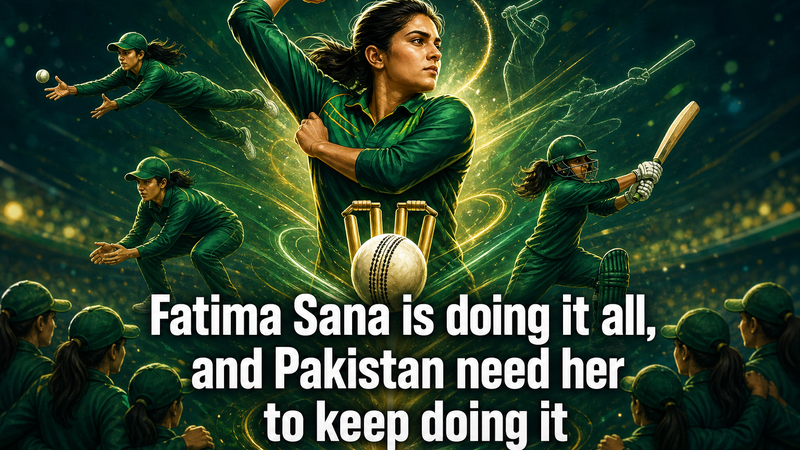
When Fatima Sana was appointed Pakistan captain in August 2024, her record suggested a work in progress. She had 40 T20 international caps, a batting average below 20, a best score of 35 not out, and a bowling average above 30. She also had less than six weeks to settle into the role before the T20 World Cup.
Nearly two years on, the picture has changed sharply. In 18 further T20Is, she averages 50 with the bat, has reached 90, and holds a bowling average under 24. Pakistan have won only seven of those matches and one series — against Zimbabwe — yet Sana’s individual form shows she is setting the standard.
Still only 24, she already has seven years in international cricket after debuting at 17. Her captaincy has coincided with difficult personal and professional moments, handled with composure throughout.
At her first major tournament as leader, her father died suddenly. She left camp for the funeral, returned to play, and was visibly emotional during the national anthem. She opened the bowling, top-scored, and Pakistan still lost heavily to eventual champions New Zealand.
A year later she led the ODI side at the World Cup, where geopolitical tensions left the team isolated in Sri Lanka while much of the tournament unfolded in India. Pakistan went winless, but Sana was their leading wicket-taker and nearly pulled off a famous win against England with four for 27 before rain rescued the opposition.
Since then her all-round impact has surged. Batting at No. 8 in Potchefstroom, she smashed 90 from 41 balls as Pakistan posted 181 against South Africa, who chased the target only off the final delivery. It remains the highest score by a woman batting at No. 7 or lower in a T20I. In the third match, which Pakistan won, she made an unbeaten 47 from 30. She finished that T20 series as leading run-scorer with a strike rate of 184.81 and followed with back-to-back fifties in the ODI leg.
Against Zimbabwe on their first tour of Pakistan, she produced a 62 not out from 19 balls — the fastest fifty in women’s T20 history, off 15 balls. Ten fours and two sixes highlighted her power on both sides of the wicket, her willingness to attack in the air, and the authority in her strokeplay.
She finished that series as second-highest run-scorer and second-leading wicket-taker, underlining her value in every department. Pakistan will need the same influence at the World Cup.
Teammate Aliya Riaz, a veteran of 110 T20Is, has praised Sana’s potential as an all-rounder and dynamic leader, noting steady growth in the captaincy role despite her youth. Riaz, who briefly led in an interim capacity in 2021, has acted as a sounding board, discussing with Sana how both can raise standards across the squad.
That development matters because Pakistan have underachieved at global events, winning only nine of 36 T20 World Cup matches across nine editions. In the last four tournaments they have managed one win apiece and never reached a knockout stage. Progress likely depends on Sana driving the team forward — and batting higher may be part of that.
She has moved from No. 8 toward No. 6, where her strike rate peaks at 184.61, though No. 5 may suit her best. The triple load of captaining, opening the bowling in England, and batting in the top five may explain why she has not settled there yet. Pakistan have other batters to build innings upfront; the hope is they share responsibility so Sana is not carrying everything alone.
Already among Pakistan’s all-time top 10 T20 run-scorers and wicket-takers, Sana’s trajectory points toward the summit of both lists. More pressingly, she has the chance to build a lasting legacy with a side that is increasingly shaped in her image.